


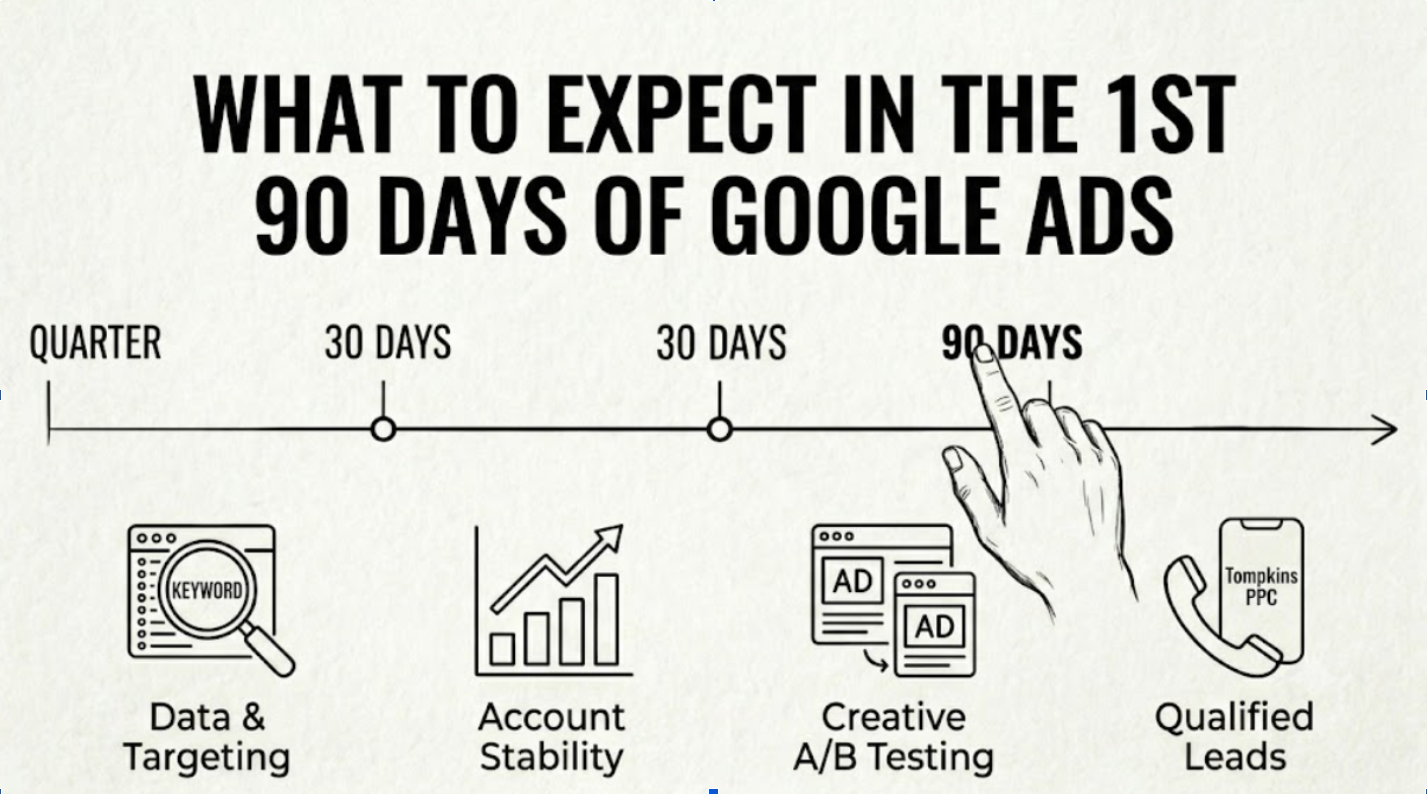
One of the most common points of friction in the first week of a Google Ads launch comes from a simple misunderstanding.
Google Ads is not a billboard.
When advertising is viewed like a billboard, the expectation is simple. The billboard shows immediately and consistently over on the side of the road. However, Google Ads are not a billboard.
That’s not how it works.
Take a common example. A Lawyer bidding on "Family Lawyer Near Me”. Google only shows three ad positions at the top of the page. In many markets, five or more lawyers are competing for those same spots at the same time.
 *Sample search for “Lawyer near me” done in Cocoa Beach, Florida
A new account does not automatically win one of those positions just because it is turned on.
Google evaluates advertisers based on multiple signals, including relevance, bidding behavior, and account history. Accounts with established performance data have more trust built up with the platform. A brand new account is still earning that trust. This is what they call Search Impression Share and is a KPI we use to measure success.
This is also why our launch process is intentional. We build accounts over the weekend for a soft launch, with the goal of having ads live and beginning to ramp at the start of the week on Monday. That initial period allows us to confirm everything is serving correctly and begin collecting early signals before real volume kicks in.
This means the initial goal is not to show every time someone searches. The goal is to get ads serving, gather early performance data, and begin establishing credibility with Google.
During this phase, we often (Search Campaigns only) start with Max Clicks bidding and move into more controlled strategies once we understand how the account behaves in the auction. The first week is about ramp up, not dominance.
The initial build is a starting point, not a finished system. Early adjustments are expected.
Google Ads requires finesse. It is not a launch and let run marketing effort. We are not building for a single day or a single week. We are building for the long game.
What the Initial Build Really is
The initial Google Ads build is not a guess. It is an educated hypothesis based on our decade plus experience running Google Ads.
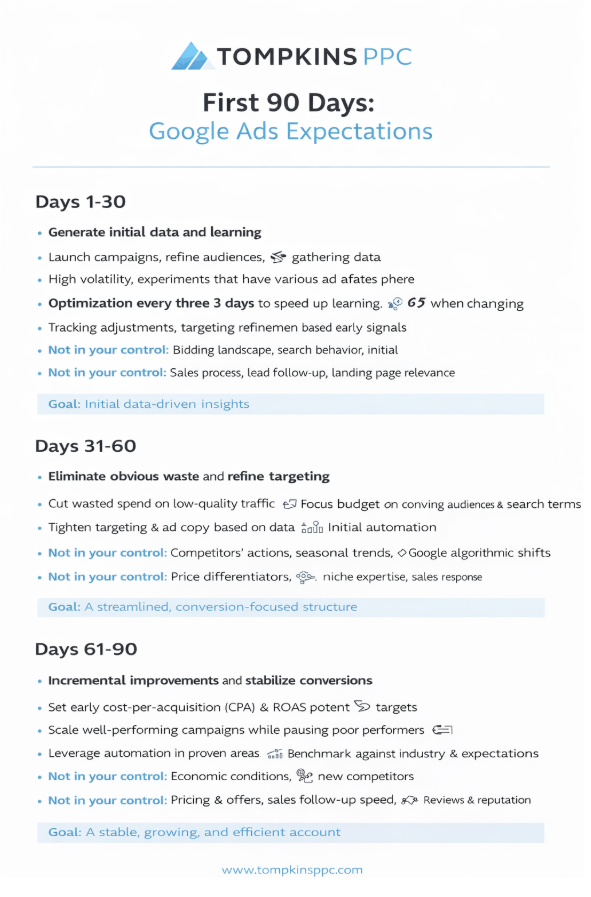
Before launch, we evaluate your core services, the most common phrases someone would use to find them, and the competitive landscape in your market. Depending on budget and available data, we may also plan supporting campaigns across other Google platforms such as YouTube, Display, Gmail, or Shopping.
That strategy is shaped by experience and by the data you already own. Analytics audiences, existing customer lists, and historical performance all influence how the account is structured from day one.
That said, no matter how experienced the team is, the initial build is still a starting point.
Until the account is live, we do not yet know how users will actually search, which queries will dominate spend, or where intent and waste will separate. That information only comes from real world data.
This is why early changes are expected and encouraged. Adding negatives, pausing underperforming ad groups, testing bidding strategies, and evaluating conversion rates are signs the system is working, not signs something went wrong.
In week two, clients receive their first report from us. This is a one page Google Analytics snapshot delivered every Wednesday, designed to give a clear view of overall website acquisition health across paid, organic, and social traffic. It is intentionally simple and meant to be reviewed quickly over a cup of coffee.
The goal of the initial build is momentum and data. Once those exist, the account can begin evolving with purpose.
What to Expect in the First 30 Days
The first 30 days of a Google Ads account are about signal collection and control, not scale.
During this period, our primary focus is making sure campaigns are ramping up, search terms are being reviewed, and wasted spend is being identified early. This is when the bulk of negative keywords are added, bids are adjusted, match types are refined, and conversion tracking is validated based on how people actually search in the real world.
It is normal for performance to feel inconsistent at this stage while the average cost per lead may fluctuate. Volume may be uneven, some days will be quiet while others may spike unexpectedly.
What matters most in the first month is search quality and data integrity. We are making sure budgets are being spent in the right places before bidding more aggressively with your budget.
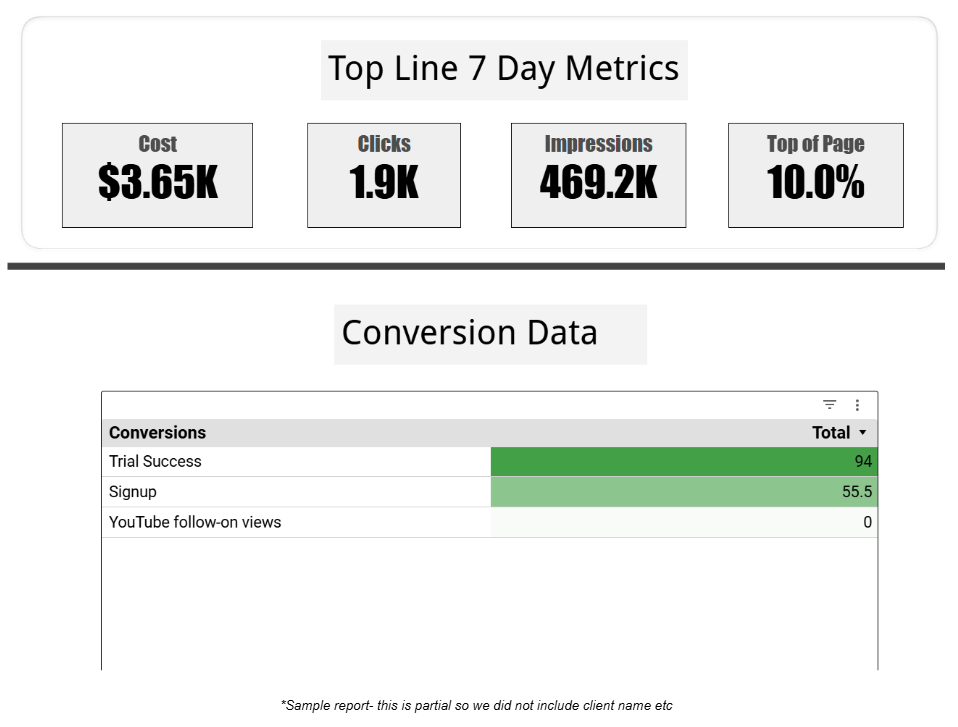
Starting on the third Monday after ads go live, clients also begin receiving a weekly Google Ads report. This is a last seven day view designed to be reviewed quickly. It highlights top line KPIs including ad spend, clicks, conversions, and light campaign level performance. It is meant to give clear visibility into how the account performed the prior week without over analysis.
End of 30 Days
Reasonable expectations
- Ads are live and consistently serving
- Search terms are being actively refined
- Reporting cadence is established
Unreasonable expectations
- Immediate profitability
- Ads showing for every search (that likely won’t ever happen. Read more about Search Impression Share)
- Consistent cost per lead
By the end of the first 30 days, the goal is clean data, stable delivery, and a clear understanding of how people are actually searching for the services you offer.
What Changes in Days 31 to 60
Days 31 to 60 are where patterns start to emerge.
We have enough real search data to separate strong intent from noise at this point. Campaigns have all gone through their Learning Phase and we can see which keywords consistently drive quality traffic, which search terms need to be excluded, and where budget should be shifted. We should also know if Dynamic Search Ads will be a go-to strategy in your account after testing both URL & Category targeting.
This is also when bidding strategies often evolve. With cleaner signals and more reliable conversion data, we will likely start testing our 1st Conversion based bidding strategies having successfully transitioned from Maximized Clicks to Manual CPC. Our signals are cleaner and more reliable.
Structurally, this is when meaningful changes begin to happen. Campaigns and new Ad Groups may be separated by service or intent while underperforming may be paused. Supporting campaigns such as Performance Max, YouTube, or retargeting are likely to be introduced into the media mix.
This period also marks an important reporting milestone. You’ll receive their first comprehensive Google Ads report on the 1st of the month which provides a full account breakdown, ad group by ad group, along with year to date performance. It includes core metrics such as cost, clicks, conversions, and cost per lead. We review this report together so clients fully understand what is driving performance. We care deeply about transparency and trust so our reports pull directly from Google Ads which doesn’t give us even the ability to fudge numbers. It’s honest, direct and most importantly should give you a great view of your entire account performance.
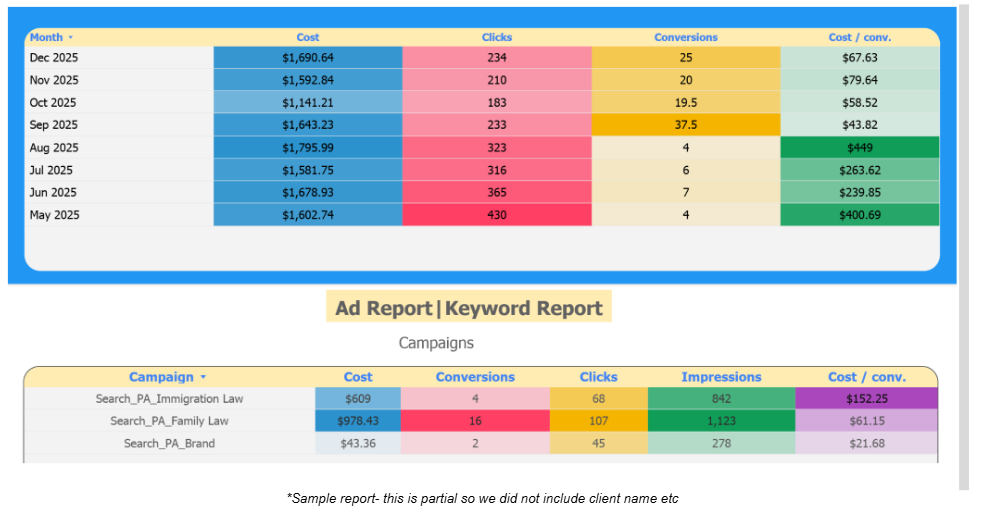
Your account performance should feel a lot more consistent by the end of your second month.
End of 60 Days
Reasonable expectations
- More stable performance trends
- Clearer winners and losers
- Structural improvements based on data
Unreasonable expectations
- Aggressive scaling without proof
- No changes to campaigns or ads
- Flat performance every week
By the end of 60 days, the goal is direction. We should know which campaigns, keywords, and services are worth continued investment and which are not.
What Stabilizes in Days 61 to 90
Days 61 to 90 are about proof of concept.
By this point, we should have a clear understanding of whether the account can be profitable. The noise from the initial launch has been filtered out, the major structural adjustments have already been made, and we search term intent is no longer nebulous.
This is where performance starts to tell a more complete story.
Our goal during this phase is typically to approach break even. Not perfection, not aggressive scaling, but controlled validation. We want to confirm that the campaigns, keywords, audiences, and bidding strategies in place can produce sustainable results.
By now, we should know which services convert consistently, which campaigns deserve more budget, and which elements from the initial build needed to be adjusted or removed. In most cases, those changes have already been implemented and tested.
This period becomes the foundation we build on moving forward.
Once proof of concept is established- the expectation shifts. After the 90 day mark, the focus moves toward profitability and scale. Budgets are increased intentionally, successful structures are expanded, and supporting channels are layered in with confidence.
Days 61 to 90 are about clarity. Everything after that is execution.
End of 90 Days
Reasonable expectations
- Clear profitability path or informed pivot
- Confidence in what works and what does not
- Intentional budget increases where justified
Unreasonable expectations
- Google Ads fixing a broken business model
- Scaling without operational readiness
- Set it and forget it performance
By the end of 90 days, the goal is proof of concept. We should know whether the account can be profitable and what levers to pull to move toward scale.
How to Measure Success Across the First 90 Days
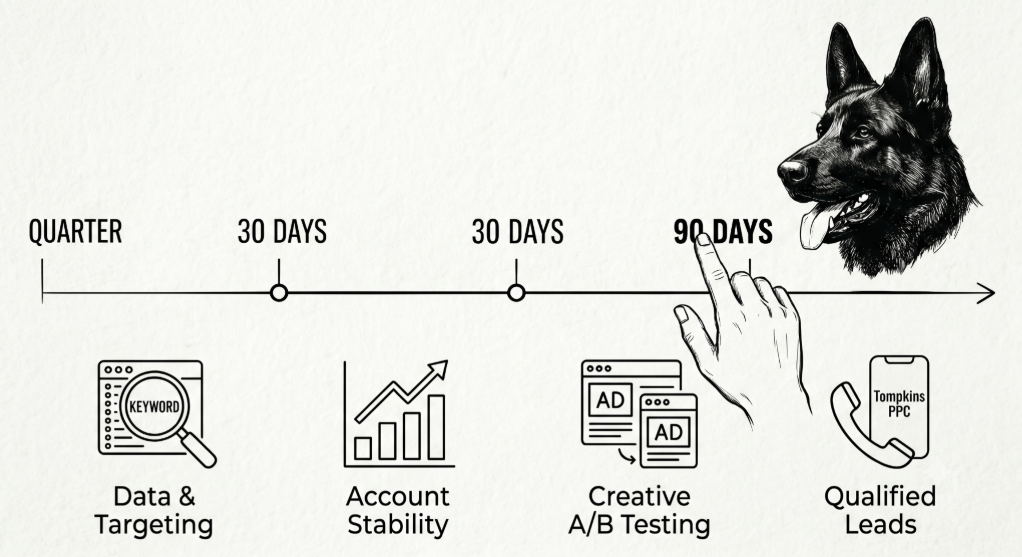
The biggest mistake clients make with Google Ads is judging success too early or by the wrong metric.
In the first 30 days, success looks like clean data, controlled spend, and clear signals.
In days 31 to 60, success looks like direction, structure, and improving consistency.
In days 61 to 90, success looks like proof of concept and a clear path to profitability.
Each phase builds on the one before it. Skipping steps or rushing scale undermines the process and usually leads to wasted spend.
Our role during this time is to ramp up responsibly, protect budget, and make decisions based on real data rather than assumptions. Your role is to stay focused on the timeline, not the daily noise.
By the end of the first 90 days, there should be no mystery left in the account. We should know what works, what does not, and what comes next.
That clarity is what allows us to move forward with confidence.
Lastly,
Google Ads will grow your business, but it cannot save it.
It amplifies what already exists. Strong offers, solid operations, and good follow up get stronger. Weak foundations get exposed faster.
Our job is to build and manage a system that gives your business the best possible chance to grow responsibly using our probability marketing philosophy. Your job is to help guide us with direct industry knowledge we can use as a team to make adjustments in your account.
Ready to Build a Scalable Google Ads Engine?
The first 90 days are entirely about transitioning your account from raw data collection to a stable, revenue-generating asset. By building a clean foundation of strict keyword targeting, creative testing, and rigorous lead optimization, we set the stage for long-term scalability.
Do not leave your growth to platform default settings or automated guesswork. Let an experienced operator build your account the right way.
Schedule a Discovery Call with Tim & lets review your Marketing Goals.

If you are starting a new Google Ads campaign or questioning whether your current one is being evaluated correctly, this framework should give you a better lens to judge progress.
If you want to talk through what the first 90 days should look like for your business, you can schedule a conversation here:
https://tidycal.com/tompkinsppc
Or learn more about how we work at:
https://tompkinsppc.com