AI has fundamentally changed how Google Ads operates.
Performance Max, Smart Bidding, broad match, and automated creative have shifted the interface from manual control to algorithmic decision making. But while the tools have evolved quickly, one thing has not changed- Results still depend on fundamentals.
In fact, as Google Ads becomes more automated, foundational decisions around structure, audience, and intent matter more than ever. AI does not remove responsibility. It simply moves it upstream.
How We Got Here
A decade ago, success in Google Ads meant managing bids, match types, and budgets by hand. Today, much of that execution is automated. Google increasingly decides when, where, and how ads appear.
This shift has allowed accounts to scale faster and reach more users across more surfaces. But it has also created a misconception that strategy is less important.
The opposite is true.
Modern Google Ads management is no longer about micromanaging levers. It is about designing clean systems that give the algorithm clear signals to learn from. When those signals are messy, AI does not correct them. It amplifies them.
Structure Still Determines Outcomes
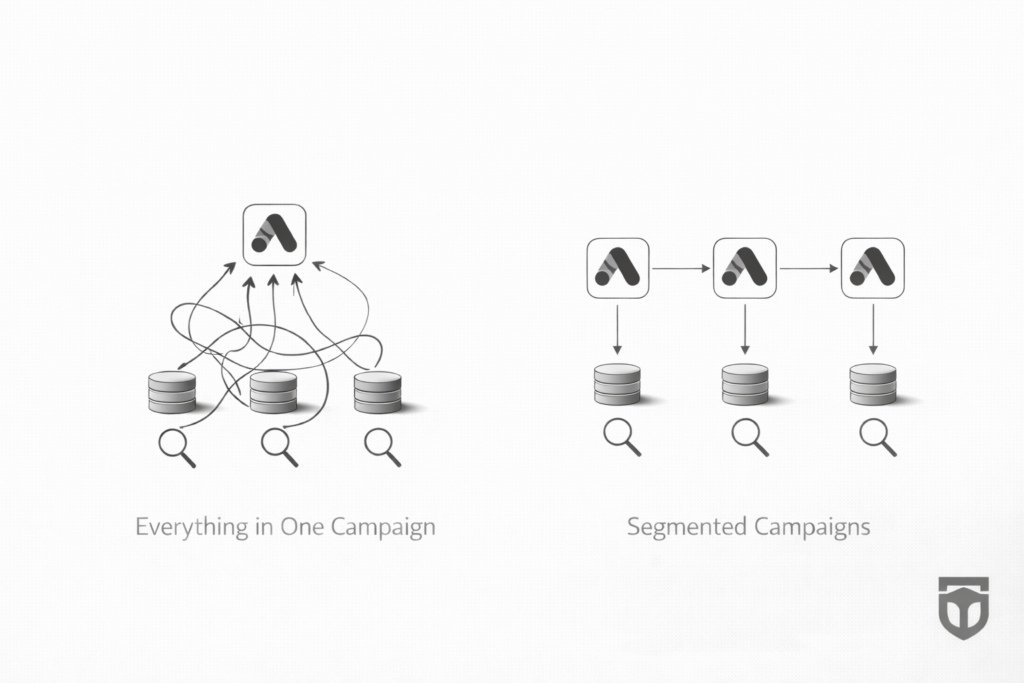
‘Automation encourages consolidation. Performance Max, in particular, makes it tempting to throw everything into one campaign and let the machine figure it out.
That approach rarely works long term.
Structure still plays a critical role in performance because it defines boundaries. Those boundaries help the algorithm understand priorities, allocate budget responsibly, and learn efficiently.
Poor structure creates problems such as:
- High and low value services competing for the same budget
- Conflicting conversion signals inside the same campaign
- Inability to isolate what is actually driving performance
A well structured account creates clean learning environments. It gives AI clarity. Without structure, automation is operating blind.
Audience Signals Are AI’s Compass
AI is powerful, but it is not intuitive. It cannot infer business context, customer quality, or long term value unless it is explicitly told.
This is where human insight still matters most.
Business owners understand their customers in ways platforms never will. Why people convert, what makes a lead valuable, and which segments actually drive revenue are insights that must be translated into signals.
First party data, analytics audiences, CRM lists, and real world context all help guide the machine. When those inputs are strong, AI performs better. When they are weak or missing, the algorithm is forced to guess.
AI does not replace audience understanding. It depends on it.
Intent Still Drives Everything
There is ongoing debate about whether keywords still matter. The more accurate framing is this.
Intent has always mattered. Keywords were simply one way of expressing it.
Even with fewer visible search terms and more automated matching, Google Ads remains an intent driven channel. The platform still learns from billions of queries and behaviors. That learning improves when intent signals are refined, not ignored.
This is why fundamentals like negatives, exclusions, and landing page alignment still play a critical role.
Understanding intent allows advertisers to:
- Prevent wasted spend from low quality queries
- Align messaging with actual buyer motivation
- Ensure landing pages match user expectations
Automation does not remove the need for intent management. It increases the cost of getting it wrong.
The Real Role of AI in Google Ads
AI is not a replacement for strategy. It is a multiplier.
When fundamentals are strong, automation accelerates growth. When fundamentals are weak, automation accelerates inefficiency.
This is why successful Google Ads management today looks different than it did years ago (Goodbye Skags). The focus is not on constant tinkering. It is on building clarity early, protecting data quality, and allowing the algorithm to scale what works.
AI excels at execution. Humans still excel at judgment.
What This Means for Advertisers
The future of Google Ads is not human versus machine. It is human insight guiding automation.
Advertisers who win are not those who chase every new AI feature, but those who understand how structure, audience, and intent influence learning. They design accounts that teach the algorithm what success looks like.
Google Ads did not become easier. It became more consequential.
The fundamentals did not disappear. They became the advantage.
Want a clearer picture of how we structure, track, and scale Google Ads accounts?
These resources may help provide additional context:
- What to Expect in the First 90 Days of Google Ads
- Why Google Ads Will Grow Your Business, Not Save It
- Conversion Tracking and Analytics Done Right
For those who prefer a structured conversation, you can also book time directly here: